 By Elena Mercer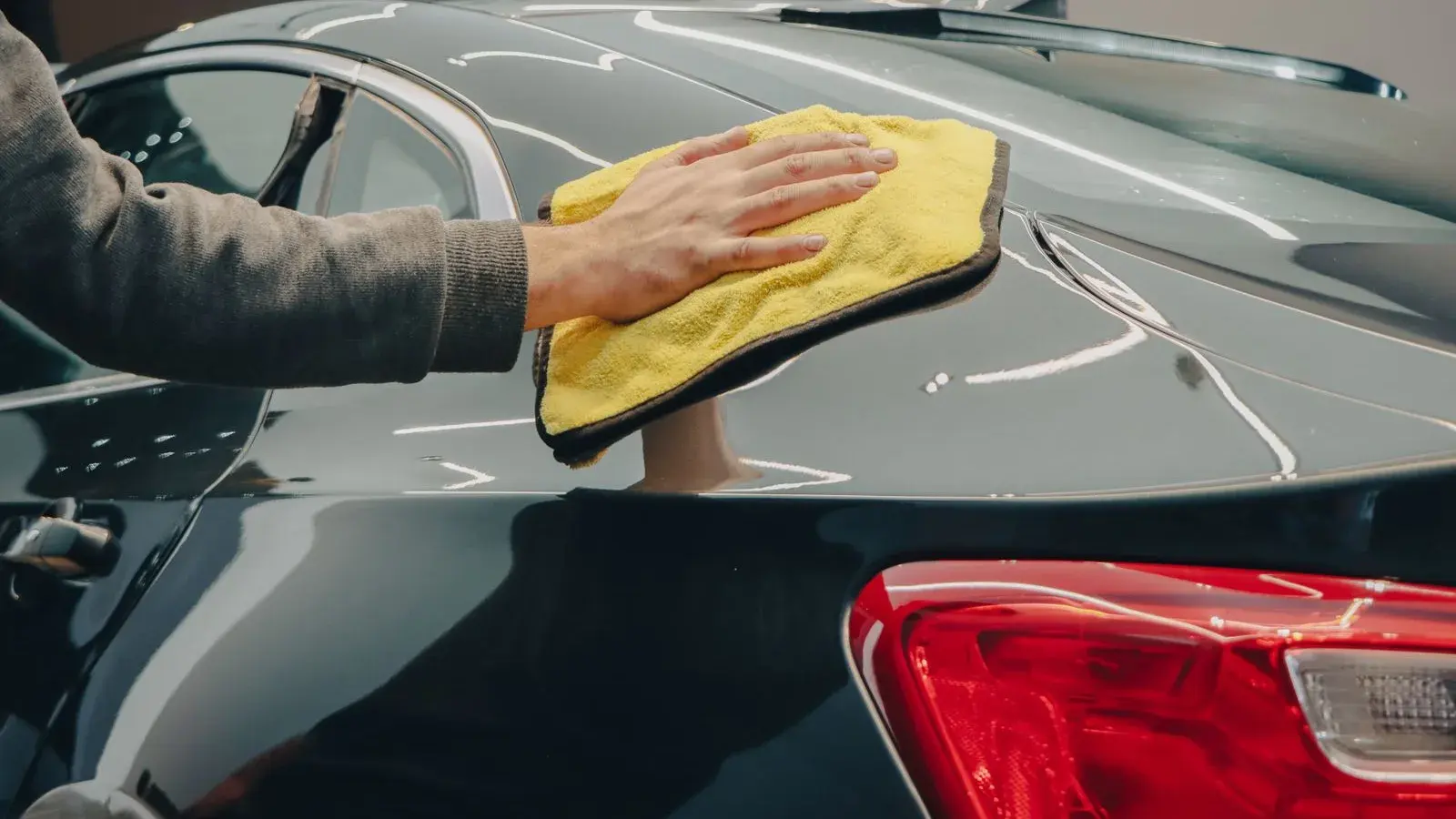
Wash microfiber towels separately from cotton and other lint-producing laundry. Sort detailing towels by task and contamination first. Use a detergent approved for the towels and washer. Follow the towel care label for temperature, then dry fully without fabric softener or dryer sheets.
The Rag Company specifies cold or warm washing for its microfiber towels. It permits low-heat, no-heat, or hang drying. Your towel and appliance instructions must both permit the chosen method.
The stock photo shows a cloth used on a car. It does not document a Detail Compass towel test or customer job.
Exclude unsafe contamination first
Keep oil, fuel, solvent, and unknown chemical contamination out of the routine laundry batch. Maytag warns that washing cannot completely remove oil. Its dryer instructions prohibit items that have contained oil or flammable material, even after washing.
Low heat does not remove that restriction. Check every used product label and safety data sheet for handling and disposal. A safety data sheet describes chemical hazards and precautions. Ask the product maker or local waste authority when instructions are unclear.
Set affected towels aside under those handling instructions. Do not use air drying as an assumed workaround for hazardous contamination. This procedure covers ordinary towels whose residues and labels permit routine laundering.
Keep task groups separate
Chemical Guys recommends separate towel groups by task and contamination. Keep wheel and engine towels out of the paint group permanently. A wash does not erase their assigned task.
| Task group | Routine storage and wash rule |
|---|---|
| Paint and drying | Keep away from wheel, engine, and heavy grime towels. Separate further when product residues need different care. |
| Glass | Use a dedicated marked bin. Keep polish and protection residues out of this group. |
| Interior | Keep separate from paint and glass towels. Check the cleaner label for laundry restrictions. |
| Wheels and dirty work | Keep a separate marked group. Exclude oily, flammable, or unknown residues from routine laundry. |
| Coating or unknown residue | Hold outside routine loads until product instructions confirm handling. Keep hardened material away from paint. |
Assign a color to each group if your stock allows it. Label each bin with the task too. Color alone cannot identify a mixed batch. Keep clean and used stock in separate marked locations.
The Rag Company also recommends washing like colors together. Wash new towels before first use. Add their task assignment to the stock record.
Wash an approved batch
- Read the towel care label, detergent directions, and washer instructions. Record a setting that all three permit. Resolve conflicts with the makers first.
- Check the batch for debris and excluded chemical contamination. Keep cotton and lint-producing items out. Do not overload the washer.
- Measure the detergent for that product and load. Use the washer dispenser or placement required by its manual. Leave fabric softener out.
- Run the permitted cycle and rinse. If residue remains, follow the maker’s rewash instructions. Hold the towels out of service until they pass inspection.
Use a microfiber detergent when the towel maker specifies one. The Rag Company names P&S Rags to Riches in its care FAQ. Its current product directions list 1 ounce for small or lightly soiled loads, and 2 ounces for larger loads.
Those quantities apply to that product. Recheck your bottle directions and machine requirements. Another detergent can have a different dose. A detergent sold for cotton too does not authorize mixing cotton into microfiber loads.
For The Rag Company towels, its FAQ sets a maximum of 140°F, equivalent to 60°C. Cold or warm is its wash instruction. The maximum is a limit, not a target setting. It also prohibits chlorine bleach and ironing.
Dry and inspect each towel
Confirm the contamination exclusions before using a dryer. Follow the towel label and dryer manual together. The Rag Company allows low heat, no heat, or hang drying for its towels. Omit dryer sheets.
Dry the towels fully. Chemical Guys recommends storing dry towels in a closed, clean location. Inspect the faces and edges before each use. Look for trapped particles, hardened areas, damaged edges, and persistent residue.
- Pass: the towel is fully dry, intact, free of visible debris and hard spots, and assigned to the correct task.
- Fail: debris, hard residue, damage, or uncertain contamination remains. Hold the towel out of service. Rewash only when its instructions permit it.
- Retire from paint: the towel fails the paint-use check after permitted cleaning. Relabel it for a suitable lower-risk task only if it is clean and safe.
This inspection is a practical screening check. It cannot prove that a towel will never scratch paint. Do not test a suspect towel by rubbing it on a customer vehicle. Replace it when you cannot confirm suitable condition.
Worked example: clean stock (hypothetical)
All counts below are hypothetical. A paint-towel batch contains 12 towels. After washing and drying, 2 retain hard particles and stay out of service. The next job needs 8 approved paint towels, with 2 more reserved for replacement during work.
- Approved stock: 12 - 2 = 10 towels.
- Job requirement: 8 + 2 = 10 towels.
- Stock check: 10 approved towels - 10 required towels = 0 spare towels.
The count passes with no stock beyond the planned reserve. If 1 more towel fails inspection, the batch has 9 approved towels. That count fails by 1. Add an inspected paint towel from clean stock or change the job plan.
Keep the 2 rejected towels out of the count. A clean wheel towel cannot fill the paint-towel shortage. Replace the hypothetical counts with the towels and tasks in your next job.
Download the towel-care checklist. It contains the filled example and blank batch fields. Record the care instructions and release count after every wash.
Use the safe maintenance wash procedure for the vehicle work. Use the first paid detail checklist to include clean towel stock in job preparation.
Sources
- Frequently Asked Questions: Microfiber care instructions — The Rag Company. Checked 2026-10-06. New-towel prewash, like-color sorting, cold/warm washing, 140°F limit, approved drying, no softener, chlorine bleach or ironing.
- How To Wash Microfiber Towels The Right Way — Chemical Guys. Checked 2026-10-06. Task and contamination separation, no cotton or dryer sheets, avoiding overload, inspection, permanent wheel assignment, and clean dry storage.
- P&S Rags to Riches Microfiber Detergent: How to use — The Rag Company. Checked 2026-10-06. Exact-product dose: 1 ounce for small/lightly soiled loads and 2 ounces for larger loads. Recheck actual bottle and machine.
- Gas dryer product guide W11755408A: Cycle guide safety — Maytag. Checked 2026-10-06. Page 2 prohibits drying items that have contained oil or flammable material even after washing. Follow the appliance safety instructions.

About Elena Mercer
Elena brings nine years of detailing experience to guides on equipment, pricing, and starting a business.
Meet Elena and read her guides