 By Elena Mercer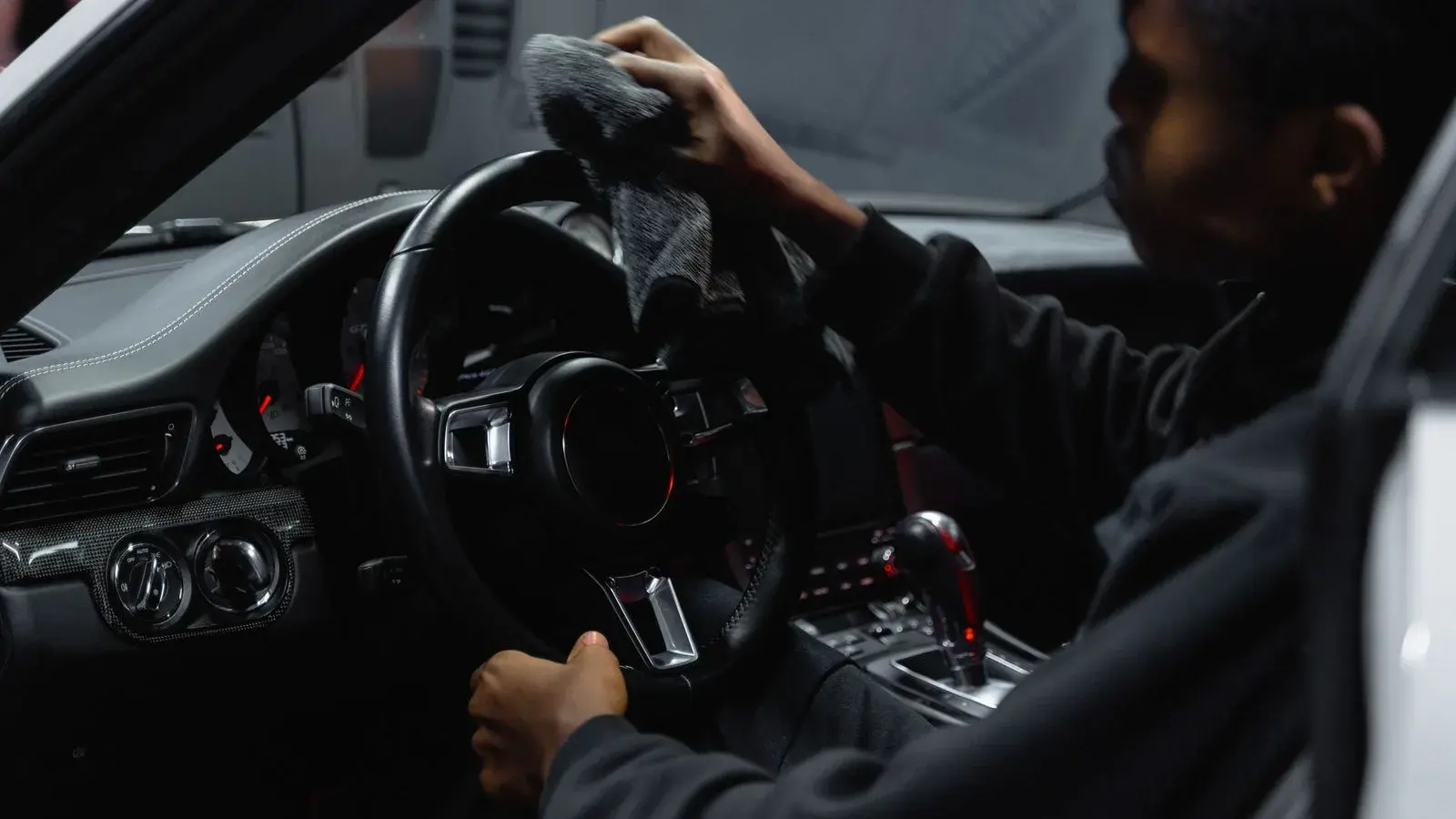
A full interior and exterior detail can take 4 to 8 hours under the scope described by Chemical Guys. That is one supplier’s planning range. Your booking estimate needs the agreed tasks, inspected condition, worker count, and product waiting times.
For a small business, build the estimate from a stage log. The hypothetical example below reserves 6 hours on site for one worker. It also counts 1 hour of off-site work. These figures demonstrate the method; they are not measured job times.
The stock photo shows interior cleaning. It does not document timed work, a customer job, or a product test by Detail Compass.
Define what full detail includes
The International Detailing Association says detailing services can vary. Put the included work on the quote. A wash, surface clean, and spray protection need a different estimate from extraction, paint correction, and coating installation.
- List the vehicle size, condition, and areas included. Record remaining stains or defects you have agreed to leave.
- Name each extra process, including extraction, decontamination, polishing, or coating. Keep excluded processes on the quote.
- Confirm site access, suitable utilities, customer availability, and the vehicle return time.
- Check the product labels and equipment manuals. Add required tests, waiting, drying, and cleanup.
Use the package guide to define the scope. Use the first paid detail checklist for inspection and handover.
Keep the time records separate
Worker hours count time each person spends working. Booking time runs from arrival to completed handover. Required waiting can extend booking time without adding the same amount of labor.
| Time record | What belongs on it |
|---|---|
| Worker hours | Inspection, setup, cleaning, checks, handover, travel, messages, laundry, and equipment care. Sum each worker’s time. |
| Booking time | The elapsed on-site schedule, including waiting that remains after safe task overlap. |
| Vehicle hold | Any further drying or product restriction that delays return or limits use. Tell the customer the exact condition. |
Record a start and finish for each stage. Record worker count and any interruption. A waiting period can overlap suitable work elsewhere on the vehicle. Add only the remaining wait to the elapsed schedule; keep its full requirement on the product record.
Two workers do not automatically cut the booking time in half. Some tasks share access or must follow another task. Plan their actual order before promising a shorter appointment.
Worked example: one worker (hypothetical)
All inputs in this example are hypothetical. The service includes exterior washing and spray protection, interior vacuuming and surface cleaning, and glass. It excludes extraction, polishing, and coating. One worker performs the stages in sequence, with no required wait remaining.
| Stage (hypothetical) | Worker minutes |
|---|---|
| Inspection and setup | 30 |
| Wheels, wash, and exterior drying | 75 |
| Interior vacuuming and surface cleaning | 105 |
| Spray protection and glass | 45 |
| Final checks, handover, and packing | 30 |
On-site work = 30 + 75 + 105 + 45 + 30 = 285 minutes. That is 4 hours 45 minutes. Add a hypothetical 45-minute booking buffer for overruns. The planned booking takes 330 minutes, or 5 hours 30 minutes.
A 6-hour window has 30 minutes left after that buffer. The base booking passes. The buffer is extra schedule space; record actual labor when it is used.
Off-site work is a separate hypothetical 60 minutes: travel 40, messages 10, and laundry or equipment care 10. Estimated worker time totals 345 minutes, or 5 hours 45 minutes. That total excludes unused buffer and includes off-site work once.
| Case (all hypothetical) | On-site work | Buffer | Booking total | Result in a 6-hour window |
|---|---|---|---|---|
| Low: interior takes 30 minutes less | 255 min | 45 min | 300 min / 5 hr | Pass; 60 min remain |
| Base: listed scope | 285 min | 45 min | 330 min / 5 hr 30 min | Pass; 30 min remain |
| High: interior takes 60 minutes more | 345 min | 45 min | 390 min / 6 hr 30 min | Fail; 30 min over |
The high case fails the booking check. Reserve a longer appointment or agree a smaller scope. Keep the required safety and product steps. Use the corrected worker-hour estimate when pricing the job.
Add drying and product waiting
Check surface suitability and the manual before wet cleaning. The Kärcher Puzzi 8/1 manual requires a hidden-area test for color fastness and water resistance. This manual also limits device operation to indoors. Follow the exact equipment and vehicle instructions for your job.
The manual says extra suction passes without spraying shorten drying. It also instructs users to leave cleaned areas unused until fully dry. It provides no universal vehicle drying duration. Check the actual upholstery and record the return condition; add remaining drying to the schedule.
Reserve equipment care after cleaning. The Puzzi manual includes flushing, emptying tanks, cleaning, and drying the device. Put that work in the time log. Keep disposal within the approved local wastewater plan.
Coating requirements can extend the vehicle hold beyond cleaning. Gtechniq requires Crystal Serum Light vehicles to stay indoors for 12 hours after application. Its application instructions also set a 5°C to 25°C temperature range. These are exact product requirements; recheck the current instructions.
An indoor hold does not mean 12 hours of continuous labor or prove complete curing. Schedule the required facility and aftercare separately. Do not shorten a product requirement to fit a same-day promise.
Check the booking before confirming
The booking passes when the complete elapsed plan fits the agreed window and required vehicle hold can be met. Include inspection, packing, handover, remaining waiting, and a stated buffer.
- Pass: the planned booking total stays within the available window. The site can meet every required product and equipment condition.
- Fail: the booking exceeds the window, or a required condition is unavailable. Extend the booking, change the site, or revise the agreed service. Rerun the check.
If you inspect a vehicle and find extra work, revise the estimate and obtain approval. Do not use the buffer as permission to add a service. Tell the customer whether the change affects price, return time, or aftercare.
Replace estimates with recorded time
Keep separate logs for comparable scopes and vehicle conditions. Record planned and actual minutes, worker count, remaining wait, and the reason for an overrun. Remove customer names, contact details, and license plates from any shared example.
Review your next 4 to 8 comparable jobs as a starting check. This is a suggested practice sample, not a reliable average for every vehicle. Replace the hypothetical inputs with your records. Keep unusually difficult jobs visible rather than removing them to shorten the estimate.
For a hypothetical two-worker task lasting 60 minutes, total labor is 2 x 60 = 120 worker minutes. Elapsed time is 60 minutes. Sum worker minutes across tasks and divide by 60 to calculate worker hours. Keep the calendar schedule separately.
Download the TXT time log for the filled example and blank fields, or use the CSV stage log in a spreadsheet. Enter total worker hours in the pricing tool. Put vehicle work in Hands-on hours. Put inspection, setup, handover, packing, travel, messages, and equipment care in Support hours. Count each task once.
For the hypothetical base case, vehicle work is 225 minutes, or 3.75 hands-on hours. Support work is 120 minutes, or 2 hours. Both fields total 5.75 worker hours. Do not enter that combined total in Hands-on hours and add Support hours again.
Sources
- How Long Does It Take to Detail a Car? A Realistic Guide — Chemical Guys. Checked 2026-10-05. Supplier orientation range of 4 to 8 hours for its described complete interior/exterior scope. This is not a measured industry average or Detail Compass test.
- What is Detailing? — International Detailing Association. Checked 2026-10-05. Service inclusions vary and customers should identify the specific services required. Official web search text was available; direct page retrieval was blocked.
- Puzzi 8/1 and Puzzi 8/1 Adv operating instructions — Kärcher. Checked 2026-10-05. Hidden-area color-fastness and water-resistance test; indoor operation; extra suction passes shorten drying; cleaned areas remain unused until dry; equipment flushing and cleanup.
- Crystal Serum Light application information — Gtechniq Australia. Checked 2026-10-05. Exact Crystal Serum Light instructions require 12 hours indoors after application and an application temperature of 5°C to 25°C. Current US official search text confirms these points. No claim about complete cure, shelf life, or other coatings.

About Elena Mercer
Elena brings nine years of detailing experience to guides on equipment, pricing, and starting a business.
Meet Elena and read her guides