 By Elena Mercer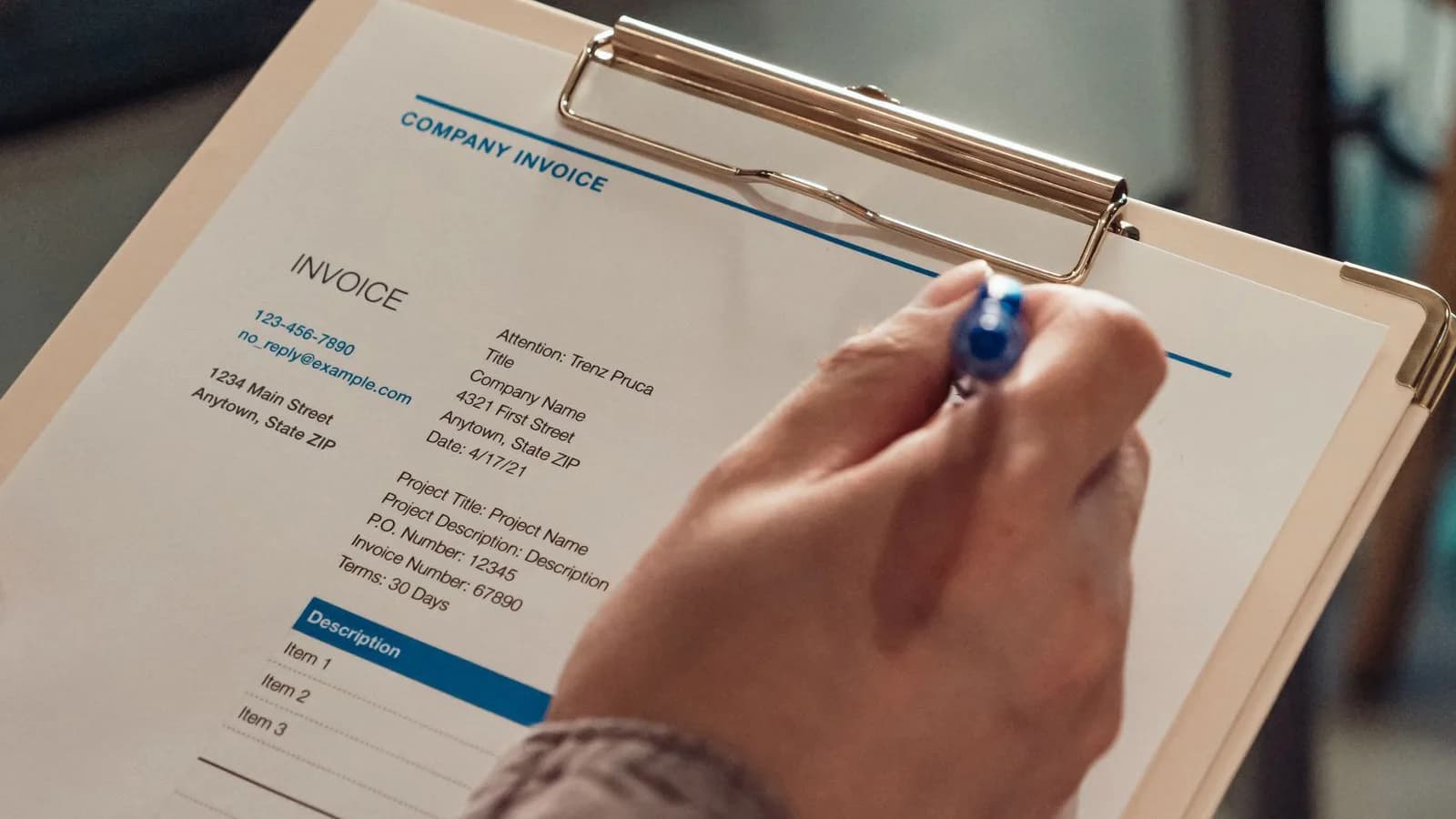
A detailing invoice closes one completed job. It records the customer, vehicle, approved work, approved changes, payment, and remaining balance. Keep the invoice with the accepted quote, change approvals, and payment record.
Download the blank plain-text invoice template or the CSV worksheet. Both files leave business, customer, vehicle, job, tax, payment, and balance fields blank.
Start with one job record
Give each invoice a number. Add the issue date and due date. Add your business contact details and the customer contact details. Then identify the vehicle and job date.
Record the accepted quote number when you used one. That number lets you compare the billed work with the approved scope. Keep the customer approval with the invoice record.
- Invoice number, issue date, and due date.
- Business and customer contact details.
- Vehicle identification and job date.
- Accepted quote number or customer approval record.
List completed work and approved changes
Write each completed service as a separate line. Use the same service name that the customer approved. Record the quantity, unit price, and line total.
Add later work in a separate approved-changes section. Record the change, the approval date or message reference, and the amount. Do not merge an added service into the original line.
| Invoice area | What to record | Why it matters |
|---|---|---|
| Service line | Completed service, quantity, unit price, and line total. | It shows the billed work. |
| Approved change | Added work, approval reference, and amount. | It separates the extra work from the original scope. |
| Tax field | Taxable subtotal, locally verified rate, and tax amount. | It keeps tax treatment visible. |
| Payment line | Date, method, reference, and amount received. | It supports the remaining-balance calculation. |
Check the totals
Add the completed service lines and approved changes. Apply tax only after you confirm the local tax treatment. Record each payment received. Subtract payments from the invoice total.
Tax rules vary by location and service. Confirm the taxable services, registration requirement, rate, and filing process with the relevant tax authority or tax professional.
The invoice passes this check when the balance equals invoice total minus recorded payments. Rerun the check after each payment or approved adjustment.
Worked example
Hypothetical inputs. One interior and exterior detail is $240.00. An approved pet-hair removal change is $45.00. The taxable subtotal is $285.00.
The example uses an 8.00% tax rate only to show the calculation. Tax is $22.80. The invoice total is $307.80. A $100.00 payment leaves $207.80.
| Line item | Hypothetical amount |
|---|---|
| Completed service | $240.00 |
| Approved change | $45.00 |
| Tax at 8.00% | $22.80 |
| Invoice total | $307.80 |
| Payment received | $100.00 |
| Balance due | $207.80 |
Download the completed hypothetical TXT example or hypothetical CSV example. Replace every example value with your own job record.
Keep the related records together
The Internal Revenue Service lists invoices, receipts, deposit information, and payment records as supporting business documents. Keep the invoice in the same job folder as the accepted quote, approval messages, and payment evidence.
Use descriptions that match the work performed. Do not add a service claim that you cannot support. Put each payment and adjustment on the invoice when it occurs.
Use the pricing tool to set the price before you send a quote. Read the first paid detail guide for the job sequence. Use the quote template for the approval record that comes before the invoice.
Sources
- What kind of records should I keep — Internal Revenue Service. Checked 2026-09-20. The article says invoices, receipts, deposit information, and payment records support business entries and should be retained in an orderly recordkeeping system.
- Publication 583, Starting a Business and Keeping Records — Internal Revenue Service. Checked 2026-09-20. The article uses the publication's cash-receipt example to keep service receipts and sales tax as distinct invoice totals.
- Advertising FAQ's: A Guide for Small Business — Federal Trade Commission. Checked 2026-09-20. The article tells operators to keep service descriptions precise and to avoid unsupported service claims, consistent with the Federal Trade Commission's substantiation guidance.

About Elena Mercer
Elena brings nine years of detailing experience to guides on equipment, pricing, and starting a business.
Meet Elena and read her guides