 By Elena Mercer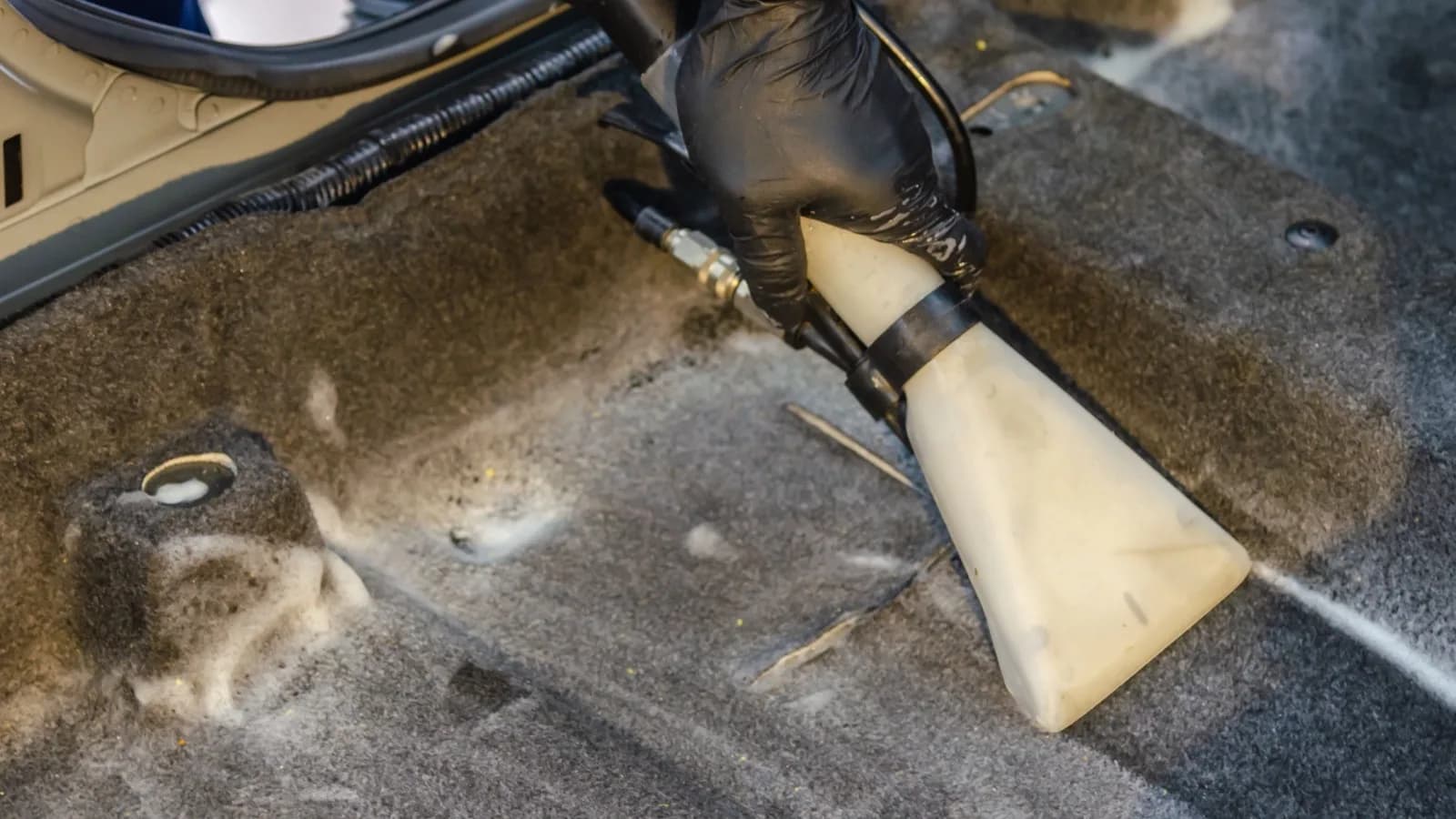
The best extractor for auto detailing is the one that fits your interior service and work site. Start with the fabric, the amount of wet cleaning, the outlet, and the space available.
A small spotter may fit occasional seats. Repeated full interiors may justify a larger tank. Neither size removes the need for a safe fabric test.
Three exact machines show the tradeoff below. The Mytee S-300 handles small jobs with a 1-gallon pair of tanks. The Kärcher Puzzi 8/1 sits between that spotter and the 4-gallon Mytee Lite 8070. These are manufacturer specifications, not measured cleaning results.
Define the service before the machine
Write the actual scope on one job ticket. Count the seats, carpet areas, mats, and fabric panels you intend to wet clean. Note whether the job calls for a spot treatment or broad extraction. Leave leather, screens, wiring, and other unsuitable surfaces outside that wet-cleaning scope.
Record where the machine will run. A fixed bay may have a known outlet, space to empty recovery water, and room to dry tools. A mobile site may have a driveway but no verified power. Check the supply at the address before you promise extraction.
Estimate your solution volume from a measured trial on suitable fabric. Record the amount filled, the amount left, and the recovered liquid. A clean tank size alone cannot tell you how many vehicles one fill will cover. Soil, tool technique, fabric, and job scope change consumption.
Keep the recovery volume as a separate line. It may differ from the solution used because fabric retains water. Empty the recovery tank at its limit. Do not use a larger clean tank to excuse a smaller recovery tank.
Check fabric and safety first
The Kärcher Puzzi 8/1 manual calls for a hidden-area check of colorfastness and water resistance. Mytee tells 8070 users to check the upholstery maker’s cleaning instructions. Apply those checks before a wet pass on a customer vehicle.
Find the vehicle or material care instructions when available. Inspect for loose dye, weak backing, water marks, stains that may spread, and electronics near the planned area. Test a small hidden area with the planned solution. Stop when color transfers or the material changes shape.
Use the detergent and dilution the machine and chemical labels permit. Mytee’s 8070 manual calls for low-foam or non-foaming detergent. A product that foams heavily can enter the recovery system. Record the label dilution on the job ticket instead of guessing.
Keep the machine and power connection away from rain and standing water. Both Mytee manuals bar outdoor use and use on wet surfaces. An awning does not make an outdoor site an indoor work area.
Use these models only where their manuals permit. Otherwise change the service method.
Check the cord and plug before every job. Keep the cord clear of doors, water, and vehicle traffic. Do not alter a plug to fit an outlet. If a circuit or outlet is uncertain, ask a qualified electrician or choose another approved power plan.
Compare three exact models
Use the table to shortlist a machine for a defined service. The figures come from current maker pages and North American manuals, checked October 1, 2026. They do not rank cleaning speed, drying time, reliability, or stain removal under a common test.
| Exact model | Clean / recovery tanks | Maker electrical and transport facts | Decision it helps with |
|---|---|---|---|
| Mytee S-300 Tempo | 1 / 1 gallon | 7 A at 110–120 V; manual calls for 20 A wall outlet; 27 lb net on current page; 20 x 10 x 16.5 in | Small spot jobs; plan for frequent fills and emptying. |
| Kärcher Puzzi 8/1 C | 2.1 / 1.8 gallons | 9 A at 120 V in North American manual; 19 lb without accessories; 20.6 x 13.1 x 17.4 in on current US page | More solution capacity with a short upholstery nozzle; check recovery volume. |
| Mytee Lite 8070 | 4 / 4 gallons | 19 A at 110–120 V; grounded 20 A outlet in manual; 45 lb net on current page | Larger wet-cleaning scope when power and transport pass. |
The Mytee S-300 product page gives its 1-gallon solution and vacuum tanks, 7-amp draw, and 27-pound net weight. It includes a 4-inch upholstery tool and an 8-foot hose. Check whether that reach works inside your vehicle and at the work site.
The Kärcher US product page lists 2.1 gallons fresh water and 1.8 gallons waste water. Its short upholstery nozzle fits confined areas. The North American manual lists 9 amps at 120 volts and says the machine is suitable for commercial use.
The Mytee 8070 product page lists 4-gallon clean and recovery tanks, a 15-foot hose, 19 amps, and 45 pounds net. Its manual calls for a grounded 20-amp outlet. Check that requirement at every planned work site.
Maker weights can use different definitions. The Puzzi page gives weight without and with accessories. The S-300 product page lists 27 pounds net; its manual lists 30 pounds. Verify the exact shipped package if carrying weight decides the purchase.
Tank size affects refills, but it is only one input. Hose reach may decide whether the machine stays outside the vehicle. Machine width, lift height, stair access, and where dirty water will be emptied also matter. Measure those paths with your actual vehicle and storage layout.
Run the power and transport checks
Read the exact model nameplate and manual. Record voltage, current, plug, cord instructions, and any heater load. A larger amp figure does not prove stronger cleaning. It tells you what electrical supply the machine needs.
The 8070 manual requires a grounded 20-amp outlet and bars extension cords. The S-300 manual also calls for a 20-amp wall outlet, despite its 7-amp draw. Both fail a 15-amp site. Check the exact outlet and circuit with a qualified electrician when uncertain.
For the Puzzi 8/1, use the North American 120-volt manual. Other regional manuals list different voltages. Do not copy a 230-volt specification into a United States comparison. Check the delivered unit’s plate against the manual.
Measure the machine at its widest and tallest point, including its handle when installed. Compare that with each door, shelf, and lift into your vehicle. A machine that fits on a product page can fail at the side door or behind a secured tank.
Use the mobile van layout guide for the door and load check. Keep a dry storage position for the power cord. Secure the machine during transport and keep recovered liquid away from clean towels.
Worked example: one interior route (hypothetical)
A detailer plans one fabric-seat and carpet service at a customer site. The trial job used 2.5 gallons of clean solution. The planned outlet is a 120-volt, 15-amp circuit.
The vehicle can take a machine up to 22 x 15 x 18 inches. These are hypothetical inputs, not typical job figures.
The S-300 has a 1-gallon clean tank. The 2.5-gallon plan needs three fills: 1 + 1 + 0.5 gallons. Its body fits the space. It fails the 15-amp site because its manual calls for a 20-amp outlet.
The Puzzi clean tank holds 2.1 gallons. The plan needs two fills: 2.1 + 0.4 gallons. Its listed 20.6 x 13.1 x 17.4-inch body fits the stated space. The 1.8-gallon recovery tank needs its own emptying plan.
The 8070 carries 4 gallons of clean solution, so one fill covers the hypothetical 2.5-gallon use. It fails the planned 15-amp supply because its manual requires a grounded 20-amp outlet. Its installed handle also exceeds the hypothetical 18-inch height.
On these inputs, the Puzzi is the only listed unit to check at the real site. Both Mytee models fail the planned outlet. The 8070 also fails the storage height. The fabric test and waste-water check remain open for every model.
| Check | S-300 | Puzzi 8/1 | 8070 |
|---|---|---|---|
| 2.5-gallon hypothetical clean-solution plan | 3 fills | 2 fills | 1 fill |
| Hypothetical 22 x 15 x 18-inch space | Fits published body size | Fits published body size | Fails with installed handle |
| Hypothetical 15-amp circuit | Fails manual 20-amp outlet requirement | Verify real supply and other loads | Fails manual 20-amp outlet requirement |
| Next action | Change site power and check refill plan | Check recovery emptying and package | Change site power and storage |
Use the table for a purchase check. It does not predict job time. Replace the hypothetical fluid use, circuit, and space with measured numbers.
A 1-gallon spotter can move ahead only when its 20-amp indoor site and refill plan pass. With verified 20-amp power and room, the 8070 returns to consideration.
Check the tool against the fabric
An extractor sprays solution and pulls liquid back through a tool. It does not replace dry vacuuming, agitation where allowed, or a material check. Remove loose soil first so the wet tool is not asked to carry grit through fabric.
The Kärcher manual tells users to test colorfastness and water resistance in a hidden area. It also describes overlapping backward passes and extra vacuum passes without spraying. Use the method only on material that passes the test and the vehicle’s care instructions.
The Mytee 8070 manual gives one wet pass followed by two dry passes as its model guidance. That is a starting procedure for suitable upholstery, not a promise that every seat dries on the same schedule. Stop if water pools or color transfers.
A heated extractor can change the solution temperature. Heat is not permission to ignore material limits. Check the fabric maker’s instructions and the machine manual. If the surface cannot take the method, offer a different scope.
After each job, empty and rinse the recovery tank as the manual directs. The Puzzi manual calls for flushing the unit and drying it thoroughly. A dirty recovery tank, clogged filter, or leaking hose can cause weak suction on the next job.
Choose the machine that passes
Write four lines on the purchase sheet: service scope, fabric test, site power, and transport. Add clean and recovery capacity as separate lines. Mark each line pass, fail, or open. An open line needs a measured answer before ordering.
Ask the seller for the exact model, included upholstery tool, hose length, current manual, parts path, and commercial-use terms. Product families and bundles can differ. Record the date and source beside each specification.
If the planned service is occasional spotting, test whether the smaller tank and shorter hose are acceptable. For repeated full interiors, check whether fewer refills save enough time to justify a larger unit. Use your own time log and quoted price for that choice.
Then check the rest of the interior kit in the mobile detailing equipment list. Record the outlet, fabric result, refill count, and recovery plan on the job ticket. Buy only after those lines pass.
Sources
- S-300 Tempo Upholstery Spotter — Mytee. Checked 2026-10-01. Exact S-300 tank, current, net weight, size, hose, and upholstery tool specifications.
- Tempo S-300 and S-300H User Manual — Mytee. Checked 2026-10-01. The S-300 manual calls for a 20-amp wall outlet despite a 7-amp draw and bars outdoor use, wet surfaces, and extension cords.
- 8070 Mytee Lite Heated Detailing Extractor — Mytee. Checked 2026-10-01. Exact 8070 tank, current, net weight, size, hose, and upholstery tool specifications.
- Mytee Lite Model 8070 User Manual — Mytee. Checked 2026-10-01. Grounded 20-amp outlet, extension-cord and outdoor restrictions, upholstery checks, low-foam detergent, and wet/dry pass guidance.
- Puzzi 8/1 C US product page — Kärcher. Checked 2026-10-01. Fresh and waste tank sizes, weight definitions, dimensions, cord, and included upholstery nozzle.
- Puzzi 8/1 North American operating manual — Kärcher. Checked 2026-10-01. 120-volt and 9-amp data, commercial intended use, hidden-area fabric test, cleaning and maintenance procedures.

About Elena Mercer
Elena brings nine years of detailing experience to guides on equipment, pricing, and starting a business.
Meet Elena and read her guides